
Our Grandmothers Were Strong: Songs of Suffrage and Strength Media

Event Detail
Our Grandmothers Were Strong: Songs of Suffrage and Strength
Dominion-Chalmers United Church 355 Cooper StOttawa,
A note from the Artistic Director

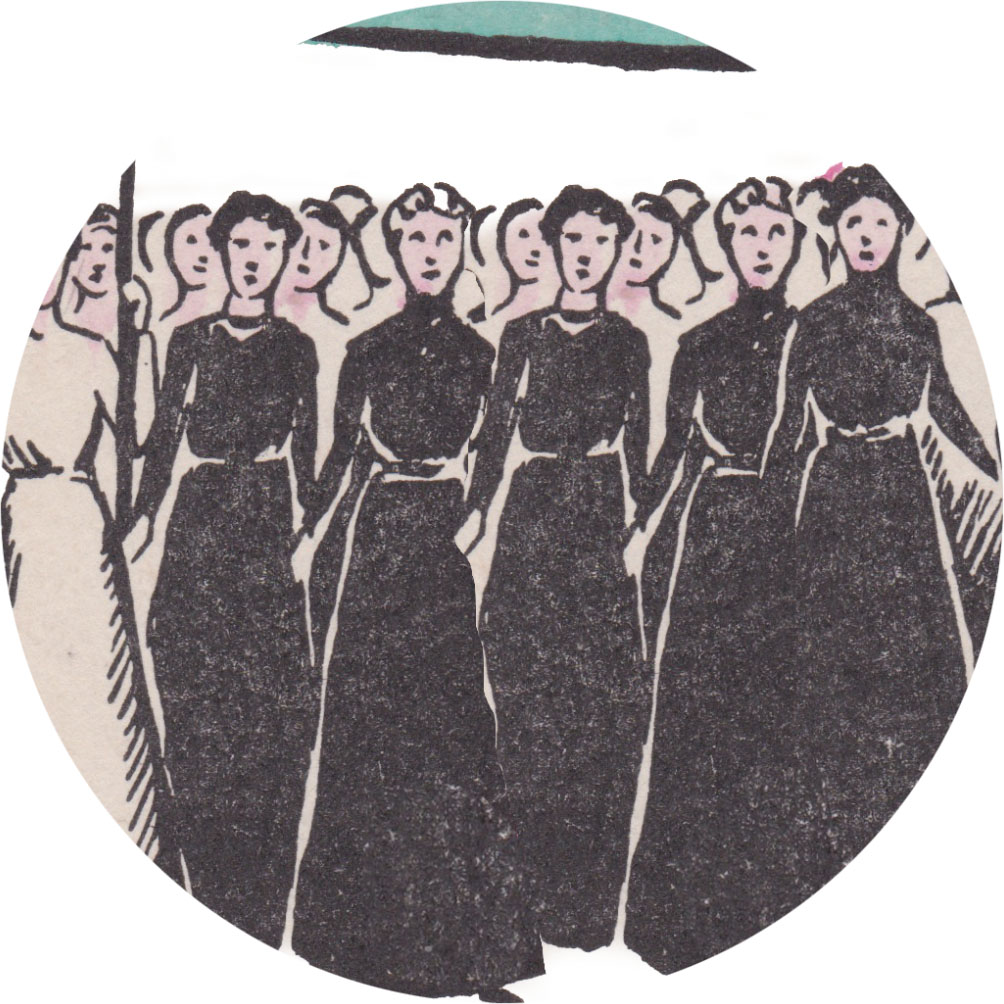
When I met with Mark O’Neill at the Canadian Museum of History last spring, we discussed an exciting range of ideas for exploring Canada’s voice through choral music. Tonight’s performance expands on the project that developed after this meeting: a concert paired with the museum’s special exhibition on women’s suffrage, performed earlier today in the museum’s Great Hall in celebration of Women’s History Month.
It seems no coincidence to have found ourselves with this theme for our first concert of this, our first official year as an ensemble named after Hypatia: a Greek woman, who, at a time when women were considered little more than property, flourished as a mathematician, philosopher, astronomer, and teacher; freely sharing her teachings to many who travelled great distances to hear her, and promoting independent thought and access to education to all.
October 30, 2016 at 7:30pm
Dominion-Chalmers United Church
355 Cooper St, Ottawa
Accompanist: Claire Stevens
Flute: Aura Giles
Percussion: Leslie Bricker
Bodhran: Luc van der Leeden
| 1 | Lineage | Margaret Walker, arr. Andrea Ramsey | Percussion: Leslie Bricker | |
| In our choir, we carry ancestry from our grandmothers from all over the world. Our ancestry includes, Aboriginal, European, British, Irish, Scottish, Russian, French, Taiwanese, Polish, Dutch, Danish, German, Norwegian, Finnish, French Canadian, and more. Tonight, we consider Women’s Suffrage through the eyes of our grandmothers, each of whom would have experienced suffrage quite differently. Looking through the lenses of class, race, place, personal beliefs and motivation, personality, education, and historical context; we examine suffrage through the many Lives of the Canadian woman. | ||||
| 2 | Vive la Canadienne! | arr. Donald Patriquin | Flute: Aura Giles | |
| A journey through the history of Suffrage reveals a complex and nuanced story that tells a much broader tale than a single-track female journey toward winning the vote. Suffragists were not a homogeneous group; nor did they focus only on suffrage. Campaigns also called for improved public health, equality in employment and education, social assistance and an end to violence. Class and race played a huge role in the Canadian woman’s experience of the movement. Suffragists were mostly white, middle-class women, many of whom believed that enfranchisement for them would increase the influence of their class and result in a better country. For example, prairie suffragists, who in 1916 were the first to win the vote in Canada, were generally convinced of the superiority of Anglo-Celtic peoples and paid little attention to Indigenous or minority peoples. Prairie men of similar class and race believed this as well. In fact, the West’s greater openness to women’s suffrage can be interpreted as a strategic move to ensure the dominance of White settler society: newly colonized regions relied on the political support of White settler women to guarantee the displacement of Indigenous peoples. | ||||
| 3 | Old Grandma (Women on the Plains, No. 1) | arr. Alice Parker | ||
| By 1914, the suffrage cause was both progressive and conservative. Growing urbanization, industrialization and immigration in the years before the First World War raised fears about how to integrate newcomers and control working-class Canadians. While some other suffragists viewed the vote as a means of strengthening White, middle-class power, others, especially those who were unionists and socialists, took up the cause of women workers, who were for the most part ill-paid and unprotected. Improving the lives of women was nothing new, though. In the 1890s, critical support had come from Canada’s largest women’s group, the Woman’s Christian Temperance Union (WCTU), whose leaders believed the franchise would help introduce prohibition and thus reduce violence. Our next piece, La Maumariée, is a French folk song about a girl’s journey to freedom from such domestic violence. This arrangement here follows the story closely and explores the emotions the main character experiences as she seeks to break away from a man her father wants her to marry, who, as the song translates, has no wealth and no money but has a stick from an apple tree that he’ll use to hit her. She proclaims, “If he hits me, I fill flee! I’ll run away to the woods with glee, where I will play and can be free, There I will learn what love can be!” | ||||
| 4 | La Maumariée (J’entends le loup) | arr. Joni Jensen | Flute: Aura Giles, Bodhran: Luc van der Leeden | |
| During the First World War, pressure mounted on federal politicians in the Conservative government of Sir Robert Borden. The government wished both to acknowledge women’s contribution to the war effort and to appeal to future female voters by extending the franchise; it also wanted to firm up support for conscription. The government also feared that voters who were born in countries with which Canada was at war would oppose conscription, especially men born in those countries. In the controversial Military Voters Act and Wartime Elections Act of 1917, the federal vote was extended to women serving in the Canadian Army Medical Corps and to close female relatives of military men. Were these select women empowered by their newfound enfranchisement, or were they pawns of the government? | ||||
| 5 | The Lass of Richmond Hill | arr. Jonathan Willcocks | ||
| At the same time the Wartime Elections Act gave the vote to these select women, it also disenfranchised thousands of immigrants from so-called enemy countries who had become citizens after 1902 as well as all conscientious objectors (those who refused to go to war because it was against their religious, moral or ethical beliefs). The Act divided Canadian suffragists, many of who opposed partial enfranchisement and disenfranchisement. This French-Canadian piece, Un Canadian Errant, speaks to the sorrow of alienation that must have been felt by those who had the vote taken away from them by their own government and in their chosen country. | ||||
| 6 | Un Canadien Errant | Arr. Mark G. Sirett | ||
| As we can see, the First World War interrupted the suffrage campaigns and divided activists. Many concentrated on supporting the war effort, including conscription, in groups such as Women’s Patriotic Fund. In 1918, with the war coming to a close, the federal government began to argue that women had earned the right to vote through their war work. On the 24th of May 1918, female citizens, not included under racial or Indigenous exclusions, aged 21 and over became eligible to vote in federal elections. Most importantly, for all our grandmothers, the war was finally over. | ||||
| 7 | After the War | P. Gross & D. Keely, Arr. Joel Forth | ||
| All along the way, women in Canada met strong resistance as they struggled for basic human rights, including suffrage. Opposition flourished wherever independent women were believed to endanger religious, ethnic or national communities. Exclusion from the franchise also remained acceptable to many Canadians because many people, men and women, believed that men had greater capacity for reason and that men’s potential for military service justified more rights. Furthermore, prevailing ideology placed women and men in separate spheres. This reflected the increased idealization of women as guarantors of cultural survival, who had no place in political life. Under this ideology, women were expected to remain at home, producing children and securing the moral health of the nation. Opposition would only dissipate as suffragists successfully reconfigured women as legitimate public subjects and the public sphere as a respectable space for women to exercise authority, and it would not be until 1929, 11 more years after obtaining the vote, that Canadian women had full access to all political offices at the national level—thanks to the successful action initiated by the Famous Five to have women declared “persons” and eligible to sit in the Senate. After World War I, Dorothy Parker, one of the most accomplished and successful feminist literary writers in women’s history, lunched daily with two fellow writers, who, with her, comprised the group known as the “Vicious Circle.” They met at the Algonquin Hotel in New York City, a few doors down from Vanity Fair where they all worked, however, Dorothy was terminated from her position there in 1920 because her criticisms, initially popular, were deemed offensive to powerful producers. She later worked for the New Yorker magazine and later moved to Hollywood where she wrote successful screenplays for Paramount Pictures with her second husband Allen Campbell. This next piece, based on her text, is, well, it speaks for itself. | ||||
| 8 | Song of Perfect Propriety | Dorothy Parker, Arr. Carol Barnett | Library Sponsorship – To my favourite pirate! | |
| 9 | Laggard Dawn | Ethel Smyth | ||
| Women’s enfranchisement in federal elections was hardly the end of the journey! There was still far to go for Indigenous peoples and minority groups, and the arrival of provincial voting rights varied from province to province. Québec was the last province to grant women the vote – it did so in1940. In Québec, suffrage supporters came from both the French and the English-speaking communities, but the former was hobbled by the opposition of the Catholic Church Catholic Church and by political fears of federal interference. Nevertheless, French-Canadian women voiced their support for women’s causes and made their strong voices heard. Our next piece, C’est l’aviron, tells a tale of a young, self-possessed French-Canadian woman, who most certainly speaks her own mind… but on her own timeline and when she’s ready! In this story, a young man thinks she would be a good partner for him, and drives her all the way to her home. Throughout the journey, they don’t way a word to each other. Finally, they arrive; she celebrates by making a toast to her father, her mother, her sister, her brother, and …her lover! That’s how it goes! | ||||
| 10 | C’est l’aviron | Arr. Donald Patriquin | ||
| Meanwhile, minority and Indigenous peoples had a completely different experience. Asian women, for example, were left out of the 1918 federal enfranchisement of women, and were not included until after the Second World War – they were viewed by society more as cases for charity than as fully participating members of the country. Indigenous women were largely invisible in the suffrage campaigns. The vast majority of Canadian suffragists were of European origin. While some were sympathetic to Indigenous women, none campaigned to include them in legislation. Indeed, there was little resistance at the time to the colonialist assumption that these were peoples incapable of adult responsibilities and not fit for inclusion in Canadian society generally. Mohawk-English writer and performer, E. Pauline Johnson, challenged this assumption, but she made little headway against the overwhelming prejudice. The daughter of a Mohawk chief and an Englishwoman, Pauline Johnson is best known for her poetry celebrating her Indigenous heritage. This piece, a setting of one of her poems, celebrates her heritage and her independent spirit. | ||||
| 11 | Kicking-Horse River | E. Pauline Johnson, Arr. Jeff Smallman | ||
| Indigenous women worked locally to improve conditions for their communities and as non-voters lobbied band councils, much as suffragists elsewhere pressured other levels of government. The 1934 Dominion Franchise Act explicitly denied the franchise to Status Indians on reserves and to Inuit in the north. Until 1951, the Indian Act also barred Status Indian women from voting for or holding office in their bands. Inuit received the vote in 1950; however, their names were rarely added to official lists of people entitled to vote, and ballot boxes were not brought to Inuit communities in the Arctic until 1962. Ottawa finally extended the right to vote to all Indigenous people, women and men, in 1960. Both sexes continued, however, to question the value of a right to vote in a nation dominated by settler communities that resisted equality, and as we know, there is still far to go in the journey of healing. Here now we take one small step forward, sharing this song meant to celebrate joy and life. | ||||
| 12 | Song of Life | Sandy Scofield, Arr. Willy Zwozdesky | ||
| The majority of Canadian suffragists relied on peaceful campaigning. Only a handful identified with the militant suffragettes led by Emmeline Pankhurst (1858–1928) and the Women’s Social and Political Union in the United Kingdom. These women participated in highly organized efforts, including a famous window-smashing event in simultaneous locations throughout London. | ||||
| 13 | The Stove | Ann Kilkelly, Arr. Zae Munn | ||
| Dame Ethel Mary Smyth was one composer who was so inspired by the aforementioned Emmeline Pankhurst’s charismatic speeches, that in 1910 she vowed to give up music for two years and devote herself entirely to Suffrage. Smyth composed Laggard Dawn, which started our second half, as well as the next piece, March of the Women, and both compositions were premiered in 1911by a chorus of Suffragettes at a fundraising concert at the Albert Hall on March 23. We wear these scarves tonight in the same colours used symbolically by the Suffragettes: Purple to represent dignity, white for purity, and green for hope. “March of the women” became “the battle cry of the British suffrage movement.” Its most famous, though least public, performance occurred at Holloway Prison in London in 1912; over 100 suffragists, including Ethel Smyth, who had smashed windows of suffrage opponents’ homes in well-coordinated simultaneous incidents all over London, were arrested, tried, and sentenced to two months’ imprisonment. One day, when Smyth’s conductor friend Sir Thomas Beecham called at the prison to see how she was faring, the warden laughed and showed him the exercise yard. The suffragists were taking their exercise by marching and singing “the March of the Women” while, from a window overlooking the yard; Ethel Smyth conducted by vigorously waving her toothbrush. | ||||
| 14 | The March of the Women (Songs of Sunrise No. 3) | Cicely Hamilton, Arr. Ethel Smyth | ||
| The next piece entitled “Warrior” was written by Kim Baryluk of the Wyrd Sisters from Winnipeg. This is a moving anthem for women, which follows the transition from a young girl, through life as an angry youth to that of an older woman. It is interesting to note how her perspective changes from the singular to the collective – referring initially to womanhood and then ultimately to sisterhood – when life holds new meaning and purpose. The lyrics were so powerful in fact that they brought me to tears one evening as I was practicing (and I know I was not the only one so deeply moved by the piece), but I’m sure the text will speak for itself, and to our closing thoughts: Although modern polling often suggests that female voters disproportionately favour more liberal causes, little attention has been paid to post-suffrage results. It is clear, however, that the suffrage movement everywhere endorsed improvements in education, healthcare and social services that would better lives for women and children. The introduction of provincial mothers’ allowances or pensions beginning in the First World War would not have occurred without feminist pressure and politicians’ fears of new voters. It is also no coincidence that Canada’s general, if imperfect, experiments with social security in the 20th century coincided with women’s increased participation as voters, activists and politicians. As democracy became nearly universal, governments were forced as never before to begin to address issues of equity and justice. Women’s suffrage was essential to that advance. And yet, we still have much work to do… | ||||
| 15 | Warrior | Kim Baryluk | ||
Audios
Gallery


